Designed Against Life: Fear, Feeding, and the Politics of Nuisance
Updated: Mar 11
By Shraddha

Walk through a newly built apartment complex in Bengaluru and look closely at its edges. Balcony grills are meshed tight. Ledges are lined with anti-pigeon spikes. Gates are tall and opaque. Soil around trees is tiled over neatly. Drains are sealed. Even the smallest crack where something might grow is filled with cement. These buildings do more than house people; they defend against life.
Urban architecture here increasingly anticipates intrusion. Not only theft, but birds, dogs, insects, rainwater, mud. A pigeon is not a bird but a hygiene issue. A stray dog is not a co-inhabitant but a safety concern. Rainwater is not seasonal abundance but flooding risk. Fear quietly shapes design. We build not just to shelter ourselves, but to insulate ourselves from unpredictability.
And yet, just outside these carefully sealed spaces, another scene unfolds. At temple corners and apartment gates, someone scatters rice for pigeons. An elderly woman leaves chapatis for cows. A resident empties leftover curry near a drain for dogs. Feeding is everywhere in the city. It looks like care, and sometimes it is. But it is also something more complicated.
Feeding reorganizes ecological behaviour. Pigeons that once foraged now gather at fixed hours. Cows wait near traffic signals because they know food will come. Dogs cluster around certain gates. Human generosity becomes a new food chain. It changes movement patterns, dependency, aggression. And when numbers increase or conflict begins, the same residents who feed often demand relocation drives or municipal intervention. Care turns into complaints.
So what is feeding? Compassion? Guilt? Control? Perhaps it is a way of easing the discomfort of displacement. We seal buildings against nesting and perching, then offer measured scraps below. We deny habitat, then provide rationed sustenance. Life is allowed, but only within limits we define.
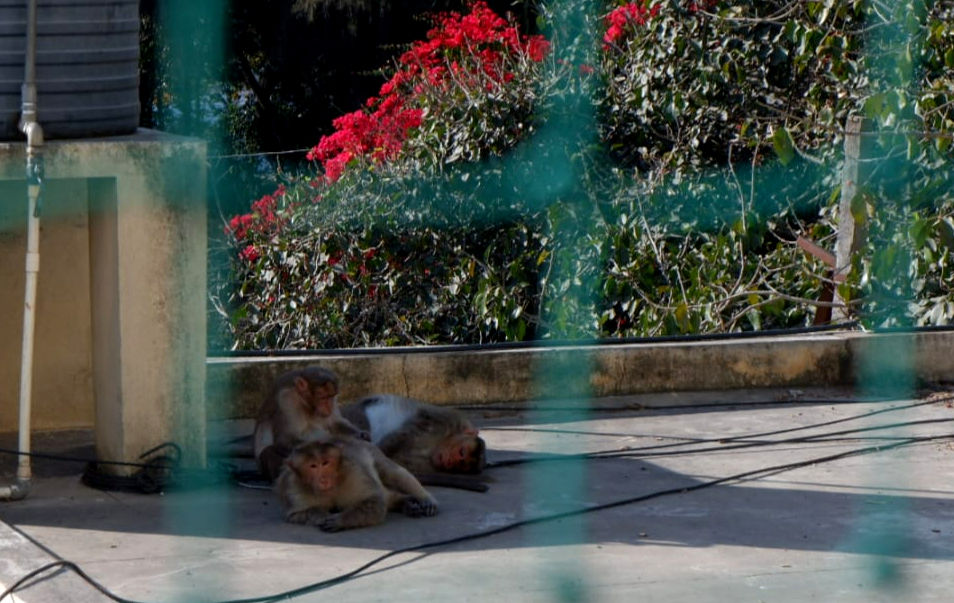
The word that often surfaces in these negotiations is “nuisance.” Monkeys are a nuisance. Street dogs are a nuisance. Cows blocking traffic are a nuisance. But the word travels further. Hawkers become a nuisance. Street vendors become a nuisance. Children playing cricket in parking lots become a nuisance. The category does not stay ecological; it spills into the social.
“Nuisance” is a powerful label because it shifts the problem onto the presence of the other, not the design of the space. If a dog sleeps on a footpath, the dog is the nuisance; not the lack of designated zones. If children play on the street, they are a nuisance, not the absence of playgrounds. If vendors occupy sidewalks, they are a nuisance, not the shrinking of informal economies. The word flattens complexity. It turns coexistence into inconvenience.
At the same time, the city carefully curates what counts as “natural.” Lakes are beautified with jogging tracks and lighting. Trees are pruned into neat shapes. Parks are landscaped and fenced with timings. But weeds growing in cracks are removed. Moss on walls is scrubbed away. Wild growth is treated as neglect, while curated greenery is celebrated as development.
Who decides what is natural enough to stay? A flowering tree planted by the municipality is welcome. A self-grown shrub pushing through a pavement is not. A fenced lake with entry hours is civic pride. An open marsh is encroaching waiting to be reclaimed. Nature, in the city, must look intentional. Wildness is mistrusted.
This is where fear and aesthetics meet. We are comfortable with nature that is shaped, pruned, timed, and supervised. We fear what exceeds the plan. Insects drawn to tube lights, stray dogs resting under parked cars, children playing loudly at dusk, all carry the unpredictability that urban life tries to manage.
The politics of urban ecology in Bengaluru is not only about disappearing forests or polluted lakes. It is about these daily decisions: spikes or nests, tiles or soil, feeding or fencing, nuisance or neighbour. Architecture, language, and care all participate in drawing boundaries around what kinds of life are acceptable.
But the boundary never fully holds. Birds return. Weeds grow back. Vendors reappear. Children find new corners to play in. Life insists - sometimes softly, sometimes disruptively. The question is whether we continue to design cities primarily around fear and control, or whether we learn to see inconvenience not as a nuisance, but as the starting point of coexistence.


Comments